I hope all of my Canadian friends enjoyed their August long weekend!
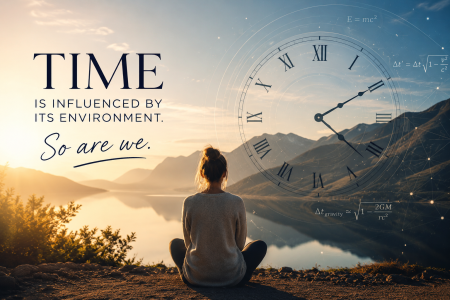
A couple of months ago, I watched a masterclass that introduced me to a fascinating study about time. The idea stayed with me because it challenged something most of us assume is true – that time is constant, unchanging, and the same for everyone.
What if time is not as fixed as we have always believed.
In 1905, Albert Einstein, introduced his theory of Special Relativity, proposing that time is influenced by factors such as speed. Later, his theory of General Relativity revealed that gravity also affects the passage of time.
Decades later, in 1971, Einstein’s ideas were put to the test in what became known as the Hafele-Keating experiment.
Physicists Joseph Hafele and Richard Keating took four highly precise atomic clocks – the most accurate clocks available – and synchronized them with clocks at the U.S. Naval Observatory. They then flew the clocks around the world on commercial airliners, with one set travelling eastward and another travelling westward.
When the clocks returned, they were no longer perfectly synchronized.
The differences were incredibly small – mere billionths of a second – but they matched Einstein’s predictions with remarkable accuracy.
The experiment demonstrated that both speed and gravity influence the passage of time. Because the eastbound flight was moving with the Earth’s rotation and the westbound flight was traveling against it, the clocks experienced time at slightly different rates. The environment surrounding the clocks influenced how quickly time passed for them.
I found this discovery fascinating because it connects beautifully with many of the themes we’ve explored together in previous newsletters.
Perhaps time offers us another reminder that nothing exists completely in isolation. Just as time is influenced by its environment, we are influenced by ours.
Of course, our experience is different. While the physical passage of time is affected by speed and gravity, our personal experience of time is shaped by our internal and external environments.
I think most of us have experienced this. A Monday morning can seem to move painfully slowly when we’re feeling stressed, overwhelmed, or dissatisfied, while a joyful Sunday afternoon can disappear in what feels like minutes.
I know this has certainly been true for me. During the annual tax season in my current 9-5, time seems to be moving backwards…and the tax slips just keep coming!
The clock itself hasn’t changed.
My experience of it has.
When we’re fighting against ourselves, living in constant stress, or resisting what is happening around us, life can feel heavy. Time itself can seem like something we’re struggling against.
But when we begin to work with ourselves instead of against ourselves – when we create safety within our nervous system, reconnect with our bodies, and align with the rhythms that support our wellbeing – life often begins to feel lighter, calmer, and more harmonious.
Perhaps the lesson isn’t that we need to control time.
Perhaps we need to become more aware of the environment we’re creating within ourselves.
Because just as time responds to its environment…
…so do we.
The question is: What kind of environment are you creating for yourself to thrive?
After all, while we may not be able to change time itself, we can change the way we move through it.

Thank you for reading.