
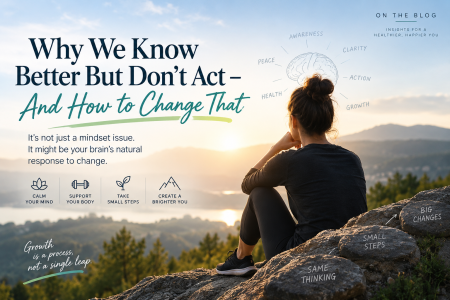
We can all remember learning something that could positively impact our lives, but for some reason, we didn’t act on it.
Maybe it wasn’t the right time. Maybe it wouldn’t work for us. Maybe it simply didn’t make sense.
But what if that response isn’t just a logical rationalization?
What if it’s actually a physiological response to a transformative learning?
I recently watched a Masterclass with Dr. Paul Scheele, who has a PhD in Leadership and Change and has spent much of his career exploring why people can become stuck even when they cognitively know there may be a better way.
What I learned really made me think about my reactions.
The Framework We Bring With Us
As children and adolescents, we develop a framework for understanding the world through our families, culture, friends and experiences.
We learn what is acceptable, what is expected and what keeps us connected and safe.
We then carry much of that framework into adulthood.
Dr. Scheele describes this as the socialized mind – where we often look to the world around us to determine what is acceptable.
So when we’re introduced to a completely new way of thinking, we need something to happen before we’re ready to embrace it: transformation.
Transformation begins with a disorienting dilemma – something that challenges the way we previously understood the world.
And that challenge causes stress.
When Stress Takes Over
Dr. Scheele describes the different levels of brain functioning and how stress can affect the way we respond.
Our old brain is focused on safety. When something feels threatening, we may freeze, avoid the situation or decide it’s simply too risky.
The midbrain is more involved with our emotional and social responses. Under stress, we may move into fight-or-flight.
Then we have our neocortex – our newer, reasoning brain. This is the seat of our left and right hemisphere representing our logical and intuitive mind.
Under stress, these two hemispheres will turn away from each other. The left, logical part of our brain will become argumentative and the right, intuitive part will turn inward and bring up feelings of unworthiness.
So What Can We Do?
We need to regulate our brain back to the pre-frontal cortex to be able to respond to this new information with clarity and logic. For me, this is exercise, meditation, breathwork and tapping.
I’ve also found that eating whole, natural foods and avoiding sugars and additives reduces stress on my body and gives me more bandwidth to deal with life’s other stresses.
Dr. Scheel recommends countering the stuck response by taking one action toward this new information.
Not a giant leap. Just one small step.
My Own Example
About ten years ago, a physiotherapist mentioned the benefits of fasting for my health, particularly around inflammation in the body.
At that time, I decided I couldn’t do it. It was too hard. I wasn’t ready.
But then fast-forward to today…
I recently completed my very first 10- day fast.
I didn’t start with 10 days.
I started with delaying my breakfast. Then one day, two days, 4 days, 7 days and then finally 10 fasting days.
I didn’t need to leap from zero to ten and neither do you.
We don’t need more willpower or discipline, maybe all we need is safety in our system and in ourselves.
I hope this helps you feel a little more comfortable taking the leap into the unknown.
Thank you for reading.

Thank you for reading.