
One of the bedrock habits of health and wellness is sleep. Ironically, it’s one I haven’t written about before because it’s a habit that has eluded me for as long as I can remember. Most nights, a full night’s sleep remains just out of reach.
Recently, I picked up – and completely inhaled – Bessel van der Kolk’s groundbreaking book The Body Keeps the Score: Brain, Mind, and Body in the Healing of Trauma. The book offers remarkable insights into how trauma affects every aspect of our lives, including something as fundamental as sleep.
For many years I’ve understood that trauma can make sleep difficult. A nervous system that remains in a constant state of hypervigilance is always scanning for danger, making it incredibly difficult to fully relax. Put simply, it’s hard to fall into a deep, restorative sleep when your brain believes a bear is charging towards you.
I’m sure I’ll return to The Body Keeps the Score in future newsletters because there is so much wisdom packed into its pages. For this month, however, I’d like to focus on just one chapter – Chapter 15 – which explores EMDR therapy and its fascinating connection to sleep.
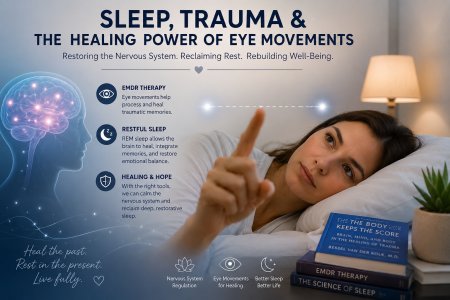
EMDR (Eye Movement Desensitization and Reprocessing) is a well-established therapy used to help people process traumatic memories. During treatment, the practitioner guides the client’s eyes from side to side, often by moving a finger while the client follows it with their eyes. Unlike many forms of therapy, the client does not need to describe their trauma for the treatment to be effective.
One theory that particularly caught my attention comes from a 1995 article by psychologist R. Greenwald titled EMDR: A New Kind of Dreamwork. He proposed that EMDR may work because it mimics the rapid eye movements that naturally occur during REM (Rapid Eye Movement) sleep – the stage of sleep where much of our emotional processing and memory integration takes place.
Dr. van der Kolk and his colleagues describe how people living with PTSD often struggle to remain in REM sleep. “…veterans with PTSD frequently woke themselves up soon after going into REM sleep-probably because they activated a trauma fragment during a dream.” (pg. 262)
The moment I read that passage, something clicked.
For years, I’ve noticed that my own sleep follows a remarkably consistent pattern. I usually sleep for only two hours before waking, almost as though my brain is reluctant to enter the deeper stages of sleep. Reading this chapter made me wonder whether my nervous system has been interrupting the transition into REM sleep as a protective mechanism.
Of course, this is simply my own observation – not a diagnosis – but it certainly gave me a new perspective on a lifelong struggle.
As many of you know, I’ve also been faithfully practicing Vestibulo-Ocular Reflex (VOR) exercises through the MS Gym. Coincidentally, I’ve just begun the final chapter of the program, which focuses on saccades – rapid eye movements from one target to another. For example, two objects are positioned apart, and the eyes quickly shift back and forth between them at a prescribed rhythm.

Thank you for reading.