March always feels like a threshold.
Not quite winter. Not quite spring. A space in between – where things are quietly reorganizing beneath the surface.
Lately, I’ve been reflecting on intention – and how we show up in the world. How our lived experiences shape not only what we believe, but what we perceive as possible.
Just before Christmas, I began listening to a meditation on abundance by Bob Proctor. Before the meditation begins, he shares his belief on human consciousness. One line in particular stayed with me:
“Man’s chief delusion is his conviction that there are causes other than his own state of Consciousness. All that befalls a person, all that is done by him, all that comes from him happens as a result of his state of consciousness.”
It’s a powerful idea.
If reality is shaped by our consciousness…if what we experience reflects our internal state…
Then what happens when science suggests that our experience of reality is also constructed through our nervous system?
Here’s where it gets interesting.
Neuroscience tells us that the brain is not a passive receiver of reality – it is a prediction machine. Based on past experiences, it constantly anticipates what is about to happen and filters incoming information accordingly. This process occurs largely outside of conscious awareness.
When the nervous system has been shaped by stress or trauma, it becomes more efficient at detecting threats. The amygdala – the brain’s threat detection center – becomes more reactive. The prefrontal cortex, responsible for rational thinking and perspective, becomes less accessible under distress.
In this state, neutral situations can be interpreted as unsafe.
Ambiguous facial expressions can look critical.
Uncertainty can feel dangerous.
If our nervous system is operating from protection, hypervigilance, or unresolved stress – it will interpret the world through that lens – not because we are failing, but because our system is doing what it learned to do to survive.
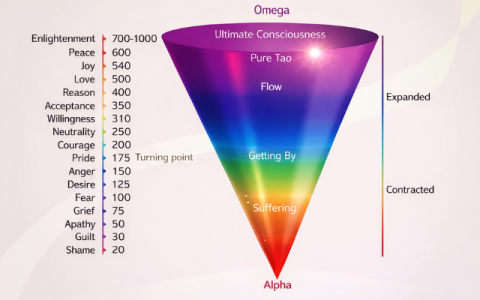
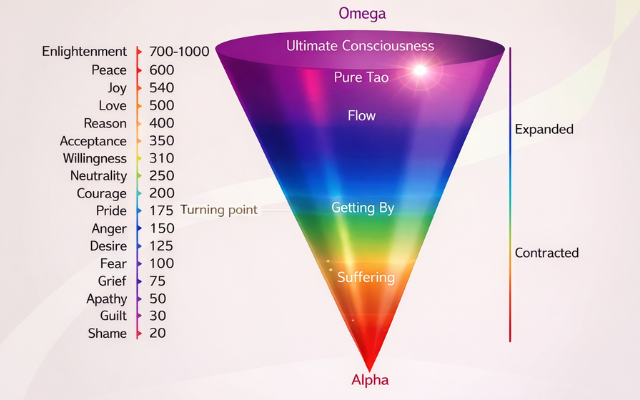
Dr. David R. Hawkins mapped what he called the Scale of Consciousness – a spectrum of emotional frequencies ranging from shame and fear to courage, love and enlightenment. Whether you take the scale literally or symbolically, it offers something valuable: a mirror.
Not as judgement.
But as information.
This is not about blame.
It’s about awareness.
A place to begin.
Curiosity instead of criticism.
Regulation instead of force.
When we tend to the nervous system – when we create safety in the body – our consciousness naturally shifts. And when consciousness shifts, our perception shifts. And when perception shifts…possiblity expands.
Perhaps the real work isn’t controlling reality.
Perhaps it’s gently calibrating the system through which we experience it.
As we step into spring, the invitation is simple:
Where am I resonating from today?
What might my nervous system need?
What would it feel like to rise – one honest level at a time?
Curiosity is a beautiful place to start.

Thank you for reading.